Origin: each Human Agency begins distinctly.
The corpus describes admission through Genesis Anchor inscription. Shared law does not mean shared identity: each Human Agency carries a distinct hash payload.
A network of Human Agencies and their causal records. Genesis Anchors establish origins; Heritage Threads carry cycle-to-cycle continuity. The illustration is architecture, not a live network map.
SOURCE-LINKEDOne human origin. Two connected views.
Predictive futures explores possibilities. Agent layers explains the roles behind them. Select the same topic in either view, then open its connected study below.
Inner to outer: near, forming and structural horizons. Placement expresses a prospective direction, not a date or probability.
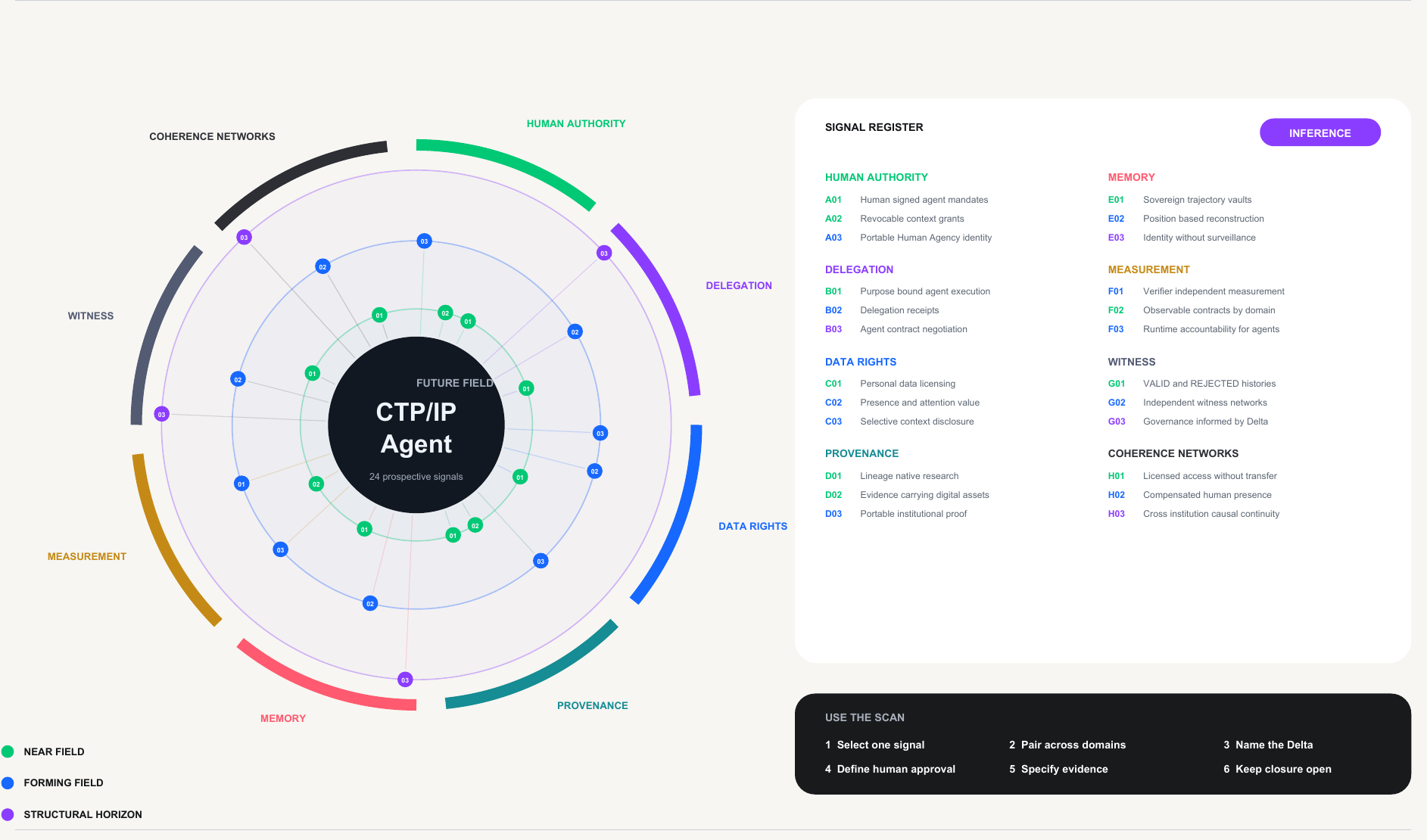
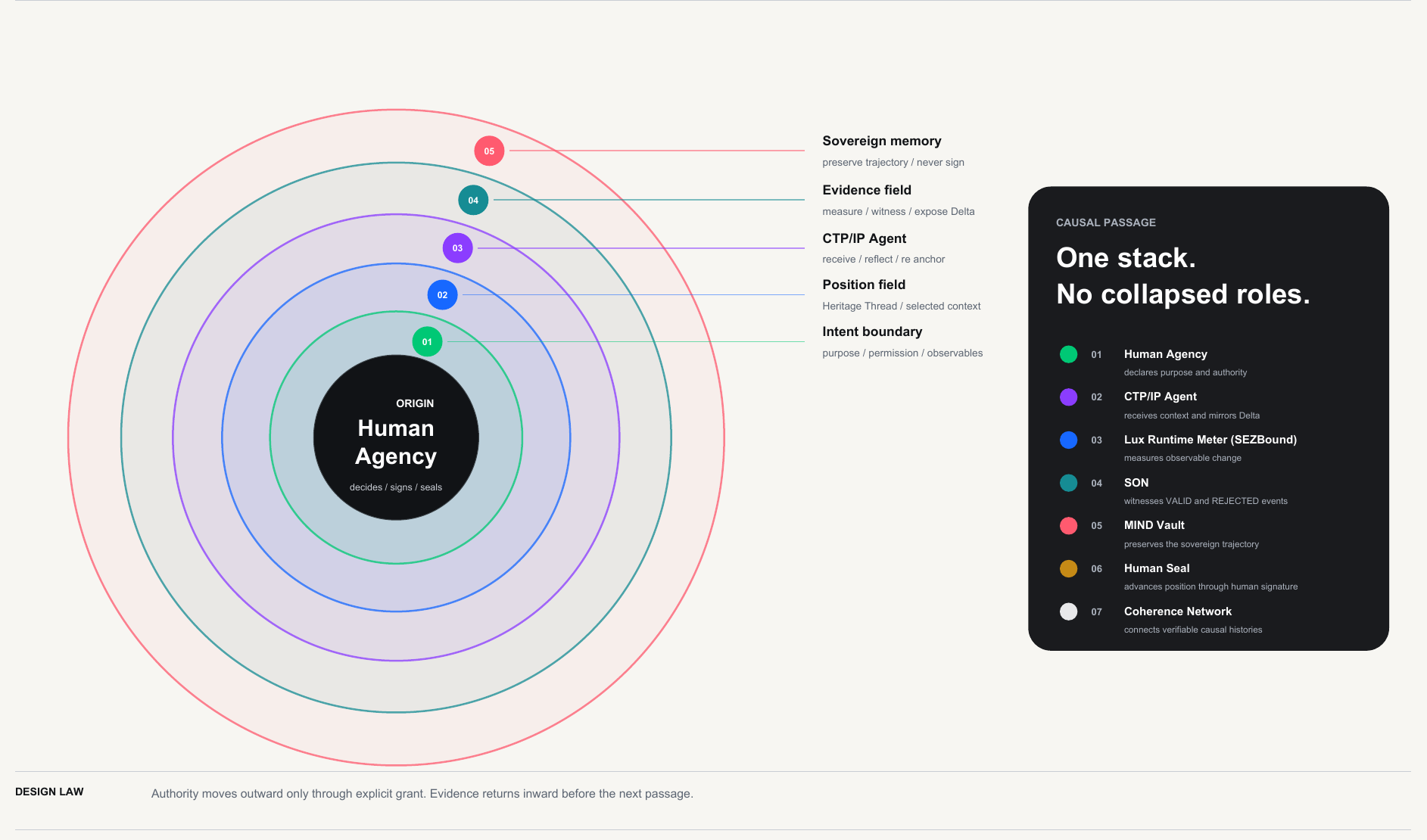
Human & agent establishes who chooses and what is shared. Access & exchange defines permission. Measurement examines change. Continuity follows the record.
Human Agency chooses what to share. CTP/IP Agent reflects that shared context. The paired dials show both sides of the same example.
Predictive futures / Human authorityHuman signed agent mandatesHuman Agency holds the intention. CTP/IP Agent receives, reviews and traces the context. The digital asset layer connects both, without handing human authority to the mirror.
Human Agency chooses. CTP/IP Agent reflects the context shared by the person.
Six Human cycle phases pair with six Agent context frames. Selecting either updates the same pair.
The same 18 contexts appear on both dials. Select Research, Music or another context to update both views.
A reproducible research studyOne selected context for both dials. Its source, intention and permissions stay together.
Orient, Anchor, Act, Reflect, Recover, Reintegrate. You choose the phase and what to share. Digital asset context stays connected to each step.
Human cycleDigital asset context
01 / OrientUnderstand the situation.
Receive. Review. Trace. The six Agent context frames organise what you share. Delta Mirror names this reflection beside its human source.
Agent contextDigital asset context
01 / Talent & capabilitiesThe mirror carries the context, not the authority.
Local example0 / 6 phases shared
Choose a Human cycle phase. Share the example. Read back the same context.
The research team
No context has been shared for this phase. Choose Share example to begin.
Which capabilities and permissions support this intention?
Share example lights the inner exchange track; Read back lights the outer exchange track. These two thin tracks sit between the phase ring and the Digital asset context ring. This example stays in this page.
Five questions about the selected Digital asset context: Research.
Trace the author, their signing authority and the artifact's history. IntentSig originates with Human Agency; an agent acts within the authority granted to it.
The research team
Delta Mirror is CTP/IP Agent's reflection of the shared context, not a separate agent. Share example writes the selected phase locally; Read back returns it. Receive shows the shared input, Review compares intention and evidence, and Trace follows its source. Nothing is collected from a connected account, written to a ledger or retained after reload.
Use Share example to share the Orient context. Only the context you choose enters this mirror.
Choose Anchor to share the example intention. CTP/IP Agent does not invent an intention from an asset or a phase.
Context, permissions and capabilities.
Which capabilities and permissions support this intention?
Is this the context I want to work from?
Choice remains with the person.CTP/IP AgentThe Delta Mirror receives before directing. It reviews differences, traces context and helps re-anchor the person's position.
No context shared for Research yet. Choose a phase, then share its example.
Internet of Value Value contexts adapted from The Internet of Value, © 2017 The Tapscott Group.
Internet of Meaning © CTP/IP: Causal Time Protocol / Intentional Processing. Author: Erico Lisbôa.
These authored scenarios illustrate Human Agency and CTP/IP Agent as the Delta Mirror. A human-selected phase updates one shared local state. CTP/IP Agent reads that same state; this map does not execute work, issue ctu or certify a result.
The six pairings are an interaction model, not the protocol's validation gates. Ethics and Governance return questions for human review, not automated judgements, approvals or policy changes. The interface is not connected to an institutional knowledge base or a ledger.
In this view, CTP/IP Agent receives and carries context, MIND Vault preserves the trajectory, SON witnesses and LUX Runtime measures. The agent and the witness have distinct roles.
Receive, Review and Trace are three ways to explore the shared context. Here they are deterministic views of authored example inputs. The map does not infer personality, measure human worth or claim to represent a complete human mind.
Asset context is not a protocol verdict.
All 18 scenarios are illustrative. Human Agency retains authority; CTP/IP Agent supports the process. Value contexts are not token listings or records from a live network.
The person confirms every transition. CTP/IP Agent does not acquire human authority.
Assets, rights and exchange contexts. Select a cell to inspect an illustrative scenario. No listing, integration or market value is implied.
Authorship, intention, coherence and transformation evidence add context to an asset. A price alone cannot answer these questions.
The upper connections illustrate continuity between Human Agency artifacts. They are not a live network, a count of agencies or a claim of protocol admission.
Human Agency reads the situation: needs, relationships and constraints. The person chooses which context to share with CTP/IP Agent.
CTP/IP Agent organises the capabilities and contributions shared by Human Agency. The context frame preserves their meaning, never a ranking of the person.
Human Agency declares the purpose, boundaries and commitments. The person anchors the intention before sharing it with CTP/IP Agent.
CTP/IP Agent connects shared sources, instruments and evidence to the declared intention. The mirrored context retains the permissions under which it was shared.
Human Agency undertakes the work with chosen instruments and permissions. The person shares the work context while retaining direction and authority.
CTP/IP Agent holds the shared roles, responsibilities and working conditions together. Its operating frame follows the purpose and boundaries declared by Human Agency.
Human Agency reviews what changed against the intention and inspects the evidence. The person decides what CTP/IP Agent may carry forward.
Consent, privacy and Human Agency constrain the mirror. Ethics take precedence over optimisation; reflecting an artifact is never a measure of human worth.
Human Agency makes room for care, repair or a different approach. The person decides when to pause, change direction and share the revised context.
CTP/IP Agent holds the shared needs, resources and unresolved constraints together. Human Agency chooses the care, repair or rebalancing needed before the work continues.
Human Agency chooses the learning and evidence to retain. The completed shared context becomes a mirror for the next cycle, not a substitute for the person.
CTP/IP Agent preserves declared permissions, accountability and decision rights. Human Agency retains authority over what is shared and what happens next.
Five example cycles. One set of inputs. Move a cycle away from intention: the Smith chart plots it, the Coherence reading shows the result, and the Brain field visualises its propagation.
One set of values, two projections. Smith geometry is a visual analogy.
Threshold reading only.
Other gates unevaluated.
No ctu emitted.
Preparing the network artwork…
Seed / Intention · Bloom / Coherence · Root / Transformation evidence. Pulses and anchors are authored visual forms, not recorded seals.
Predictive futures opens questions. Agent layers connects the roles. These four studies make their relationships explorable; Corpus Δ1 holds the protocol reference.
Read Corpus Δ1Origins and network admission