Architecture companion / Companion volume · corpus governs

The Fractal Fabric
A different kind of ledger.

The ledger that asks what caused what: the transformation signature, security by mutual constraint, the causal graph and its root, five provable capabilities, and its place beside the blockchain.

TIME FOUNDATION
PUBLICATION LIBRARY
The DAG / What caused what

Not a chain.
A graph of causes.

The Fractal Fabric is a different kind of ledger. It does not ask when something happened. It asks what caused what.

Inclusion / Precedence / Lineage / Zero knowledge / Portability

Five things the structure can prove

EDGE REJECTED: IT WOULD CREATE A CYCLEABCDEFGHI
Inclusion

Is this transformation in the fabric?

Any observer can verify that a specific transformation is recorded in the fabric without downloading the entire ledger. Cryptographic inclusion proofs demonstrate membership through hash path verification.

Conceptual graph. Selecting a proof chooses an explanation; it does not verify any record.
© The DAG - author: Erico LisbôaCorpus Δ1 ↗
The complete publication

A paper to read.
A record to inspect.

Companion volume · corpus governs. Read this publication in relation to the governing Corpus Δ1, not in place of it.

18Sections
3Source figures
2PDF layouts
Read the publicationExplore all charts & figures
Inside the paper

Mechanisms, made visible.
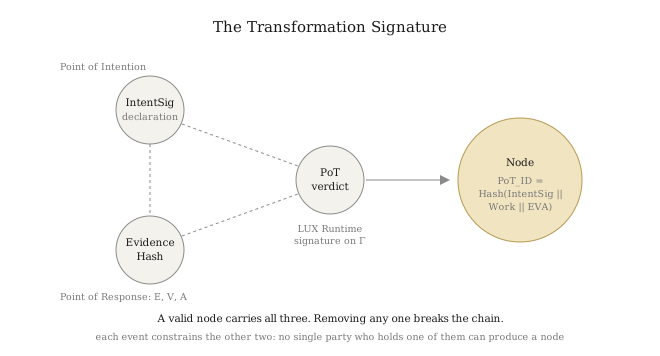
Figure 1. The transformation signature: the IntentSig, the Evidence Hash and the Proof of Transformation verdict fuse into one node; the certificate identifier is the hash of all three, and removing any one breaks the chain.
Figure 1. The transformation signature: the IntentSig, the Evidence Hash and the Proof of Transformation verdict fuse into one node; the certificate identifier is the hash of all three, and removing any one breaks the chain.Full size (opens in a new tab)

Loading the complete document index…

The figure collection

Every figure in this publication.

3 source figures
Figure 1. The transformation signature: the IntentSig, the Evidence Hash and the Proof of Transformation verdict fuse into one node; the certificate identifier is the hash of all three, and removing any one breaks the chain.
Figure 1. The transformation signature: the IntentSig, the Evidence Hash and the Proof of Transformation verdict fuse into one node; the certificate identifier is the hash of all three, and removing any one breaks the chain.Full size (opens in a new tab)
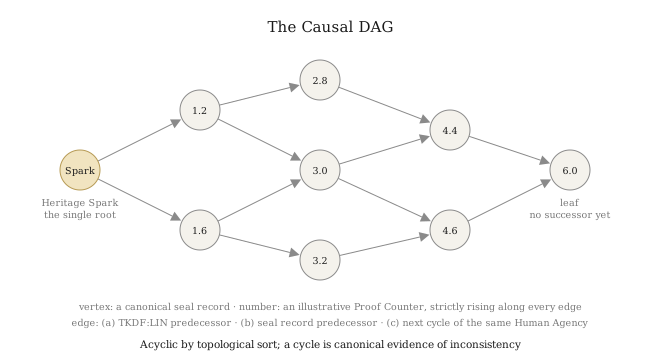
Figure 2. The causal DAG: seals as vertices, lineage as edges under three rules, a single root at the Heritage Spark, acyclicity checked by topological sort and every edge ordered by the Proof Counter.
Figure 2. The causal DAG: seals as vertices, lineage as edges under three rules, a single root at the Heritage Spark, acyclicity checked by topological sort and every edge ordered by the Proof Counter.Full size (opens in a new tab)
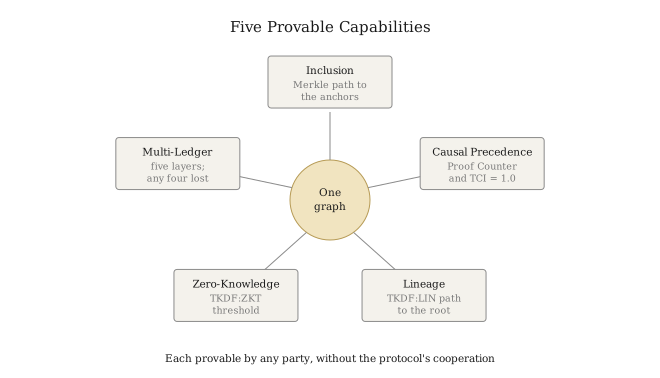
Figure 3. Five provable capabilities over one graph: inclusion by Merkle path, causal precedence by the Proof Counter, lineage to the Heritage Spark, zero-knowledge validation of a threshold, and multi-ledger portability across five persistence layers.
Figure 3. Five provable capabilities over one graph: inclusion by Merkle path, causal precedence by the Proof Counter, lineage to the Heritage Spark, zero-knowledge validation of a threshold, and multi-ledger portability across five persistence layers.Full size (opens in a new tab)