Cryptographic companion / Companion volume · corpus governs

w_AI = 0 and TKDF-256
Human authority. Causal commitment.

The human-signing-authority invariant and the TKDF-256 cryptographic lineage primitive, presented as complementary defences with explicit conformance and dependency limits.

TIME FOUNDATION
PUBLICATION LIBRARY
Explore the paper / interactive study

Assistance does not become authority.

Compare human-originated and AI-only paths through a conceptual commitment sequence. The animation illustrates ordering, not a cryptographic delay guarantee.

AUTHORITY / CONCEPTUAL MODELTKDF-256Time-bound commitmentHUMANHuman authority remains with the human.Originate intentCarry the commitmentInspect the record
01 / 3
Seed / intention / inflectionBloom / coherence / flowTransformation / Root

Conceptual illustration. No signature, seal, ctu, FLUX or transaction is produced. Read the source.

© Assistance does not become authority. - author: Erico LisbôaCorpus Δ1 ↗
Cryptography / Executable exhibit

Not a random string.
A reproducible commitment.

Select a published conformance vector. The browser computes SHA-256 over its exact byte sequence. Flip one input bit to inspect the difference.

Appendix W.7.10 / Nine public test vectors

Inside TKDF-256

Heritage verification

80 input bytes / 32 output bytes
01 / Input 11ed80be5bdf906eb259b04e9331fe4ec0cb3bc01aed5dbfb0bf9016c521825ea32 bytes · 32 raw bytes
02 / Input 2c68d5bb2a8759ea332f642c6758d82ebbf8f0d6826f4182103b9a81a2b8f5af832 bytes · 32 raw bytes
03 / Coherence3fee63f141205bc08 bytes · float64 big-endian
04 / TKDF:HER544b44463a4845528 bytes · UTF-8, appended last
SHA-256
COMPUTED DIGEST / 256 BITSComputing locally...

Waiting for local computation.

Changed inputs are an experiment, not the original record.
Inspect the published reference and complete preimage

Published expected digest

c8041da8bbde4afe00906e6d0efb64300f90d2755b92b7835a736281fb179136

Actual preimage, in input order

1ed80be5bdf906eb259b04e9331fe4ec0cb3bc01aed5dbfb0bf9016c521825eac68d5bb2a8759ea332f642c6758d82ebbf8f0d6826f4182103b9a81a2b8f5af83fee63f141205bc0544b44463a484552

The domain suffix comes last. Hashes are raw bytes; the coherence value is float64 big-endian. These are fixed source fixtures, not an arbitrary-input key derivation tool.

Browser cryptography documentation
Real local hash computation on public test data. No private keys, signatures, chain requests, seals or transactions. A hash match alone does not prove conformance or honest observables.
© TKDF-256 - author: Erico LisbôaCorpus Δ1 ↗
The complete publication

A paper to read.
A record to inspect.

Companion volume · corpus governs. Read this publication in relation to the governing Corpus Δ1, not in place of it.

16Sections
2Source figures
2PDF layouts
Read the publicationExplore all charts & figures
Inside the paper

Mechanisms, made visible.

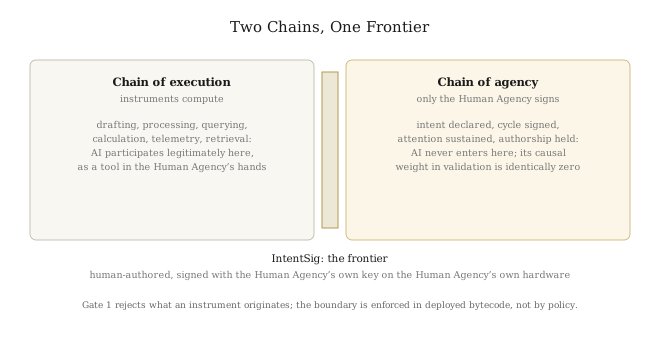
Figure 1. The two chains: the chain of execution, where instruments and AI legitimately compute, and the chain of agency, where only the Human Agency declares intent and signs; the IntentSig is the frontier between them.
Figure 1. The two chains: the chain of execution, where instruments and AI legitimately compute, and the chain of agency, where only the Human Agency declares intent and signs; the IntentSig is the frontier between them.Full size (opens in a new tab)

Loading the complete document index…

The figure collection

Every figure in this publication.

2 source figures
Figure 1. The two chains: the chain of execution, where instruments and AI legitimately compute, and the chain of agency, where only the Human Agency declares intent and signs; the IntentSig is the frontier between them.
Figure 1. The two chains: the chain of execution, where instruments and AI legitimately compute, and the chain of agency, where only the Human Agency declares intent and signs; the IntentSig is the frontier between them.Full size (opens in a new tab)
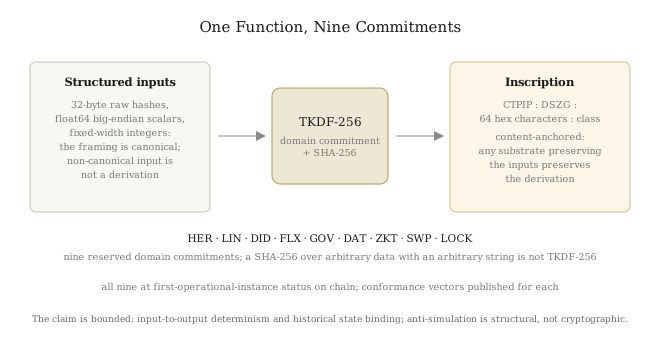
Figure 2. TKDF-256: structured inputs pass through the derivation under one of nine reserved domain commitments and produce a 64 character output inside the 77 byte inscription payload; content survives any substrate that preserves the inputs.
Figure 2. TKDF-256: structured inputs pass through the derivation under one of nine reserved domain commitments and produce a 64 character output inside the 77 byte inscription payload; content survives any substrate that preserves the inputs.Full size (opens in a new tab)