Trust companion / Companion volume · corpus governs

The Triadic Trust Model
Lineage. Correctness. Faithfulness.

Three distinct ways of establishing trust: cryptography proves lineage, reproduction proves correctness, and structure proves faithfulness. Each has a boundary.

TIME FOUNDATION
PUBLICATION LIBRARY
Explore the paper / interactive study

Three questions. Three kinds of evidence.

Switch each evidence category on or off and follow its relationship to the others. Presence is not proof, and the three roles are not interchangeable.

TRUST / CONCEPTUAL MODEL3/3categories selectedFaithfulnessCorrectnessLineage
01 / 3
Seed / intention / inflectionBloom / coherence / flowTransformation / Root

Conceptual illustration. No signature, seal, ctu, FLUX or transaction is produced. Read the source.

© Three questions. Three kinds of evidence. - author: Erico LisbôaCorpus Δ1 ↗
Triadic Trust / Three independent readings

No single witness
answers everything.

Select each leg to inspect its contribution and its limit. These controls choose an explanation; they do not confer a pass.

Structure / Reproduction / Cryptography

Three legs, one inspectable claim

FaithfulnessCorrectnessLineageTHE CLAIM
Faithfulness

Does the structure honour the declaration?

Inspect the specification, implementation boundaries and declared commitments. A digest alone cannot answer this question.

Conceptual trust architecture. Selecting a leg does not validate a claim or certify an artifact.
© Triadic Trust - author: Erico LisbôaCorpus Δ1 ↗
The complete publication

A paper to read.
A record to inspect.

Companion volume · corpus governs. Read this publication in relation to the governing Corpus Δ1, not in place of it.

15Sections
2Source figures
2PDF layouts
Read the publicationExplore all charts & figures
Inside the paper

Mechanisms, made visible.

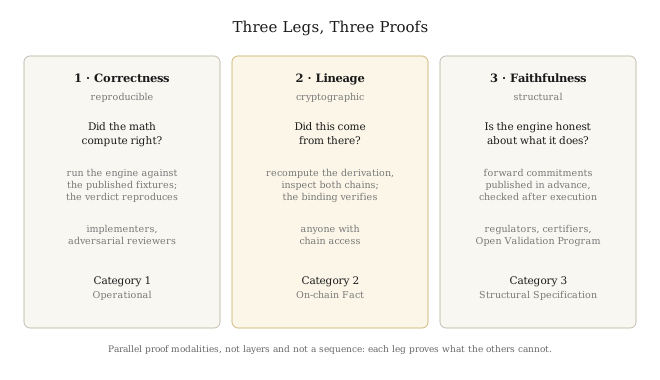
Figure 1. The three legs of the Triadic Trust Model: correctness proved by reproduction, lineage proved by cryptography, faithfulness proved by structure; each leg with its own question, proof modality, audience and claim category.
Figure 1. The three legs of the Triadic Trust Model: correctness proved by reproduction, lineage proved by cryptography, faithfulness proved by structure; each leg with its own question, proof modality, audience and claim category.Full size (opens in a new tab)

Loading the complete document index…

The figure collection

Every figure in this publication.

2 source figures
Figure 1. The three legs of the Triadic Trust Model: correctness proved by reproduction, lineage proved by cryptography, faithfulness proved by structure; each leg with its own question, proof modality, audience and claim category.
Figure 1. The three legs of the Triadic Trust Model: correctness proved by reproduction, lineage proved by cryptography, faithfulness proved by structure; each leg with its own question, proof modality, audience and claim category.Full size (opens in a new tab)
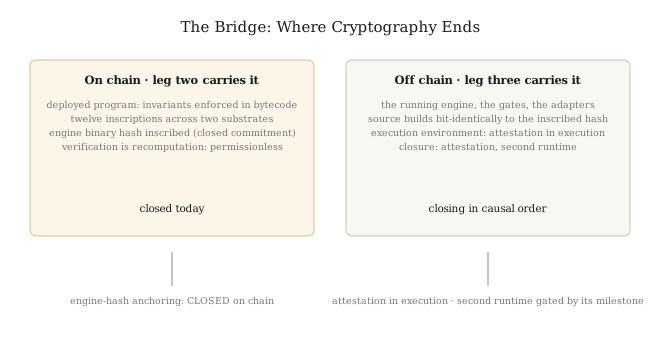
Figure 2. The bridge between the cryptographic leg and the structural leg: what runs on chain is verified by inspection and reproduction; what runs off chain is closed by the forward commitment register, with the engine-hash anchoring closed and attestation and multi-party validation closing in causal order.
Figure 2. The bridge between the cryptographic leg and the structural leg: what runs on chain is verified by inspection and reproduction; what runs off chain is closed by the forward commitment register, with the engine-hash anchoring closed and attestation and multi-party validation closing in causal order.Full size (opens in a new tab)